An AI study guide generator should produce more than a neat summary. This example ties concepts, self-test answers, and seven daily tasks to one short source.
Contents
Apply this in GitMind: Upload the source lesson to GitMind File to Mind Map and edit the branches until they match the verified concepts in this guide. Use the seven-day schedule below to decide which branches to review each day, then answer the self-test without looking at the map.
The source lesson
Original teaching source used in the examples: During a 90-minute campus workshop on October 20, 2026, participants plan a small research poster. Registration closes October 16 at 15:00 JST. The workshop is free, but travel expenses are not covered. Capacity is 24. There is a 10-minute break. If places fill, applicants join a waitlist. Submitting the form does not guarantee a place. This short, fictional notice is an editorial teaching example, not a claim about a real event.
Learning goal: read a short event notice accurately, distinguish a stated rule from an assumption, and make a justified decision. The source above is fictional teaching material. In a real course, use your syllabus and assigned reading as the authority.
The finished study guide
| Concept to remember | Evidence in the source | Common mistake |
|---|---|---|
| Deadline | October 16, 2026, at 15:00 JST. | Assuming the October 20 event date is also the registration deadline. |
| Duration and break | 90 minutes total, including a 10-minute break. | Adding 10 minutes to the 90-minute duration. |
| Cost | Workshop is free; travel is not reimbursed. | Treating “free” as including transport. |
| Capacity and status | 24 places; full events use a waitlist; form submission is not confirmation. | Assuming a submitted form secures a seat. |
Two rules help you read any source: quote the sentence that supports an answer, and mark everything else “not stated.” These rules transfer to research articles, policy notices, and exam passages.
Self-test and answer key
- When must a participant register?
- How many minutes of activities are scheduled outside the break?
- A participant has submitted the form. Can they buy non-refundable travel assuming they have a seat?
- Which sentence in the source separates the registration step from confirmed attendance?
Answers
- By October 16, 2026, at 15:00 JST.
- 80 minutes: 90 total minus a 10-minute break.
- No. The notice says submission does not guarantee a place; travel is not reimbursed.
- “Submitting the form does not guarantee a place.”
Question 2 requires a simple calculation; question 3 requires combining two source facts. If a study guide generator says the event is 100 minutes long, it has misread the break.
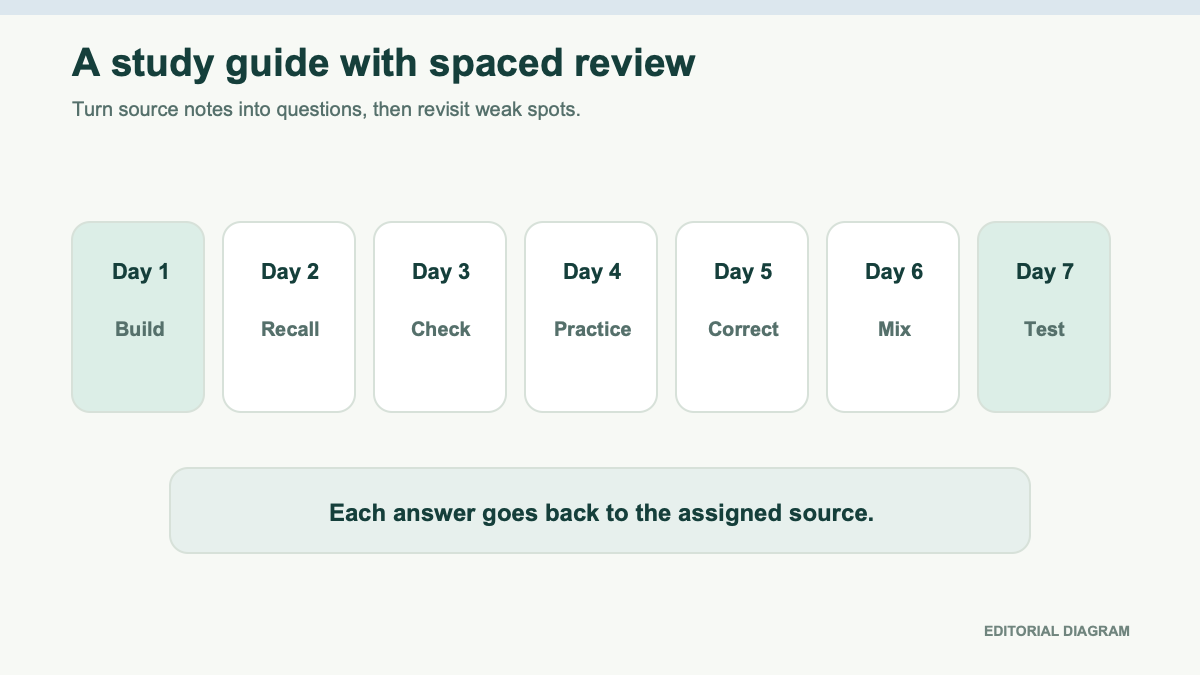
Seven-day review schedule
| Day | Task | Evidence you finished |
|---|---|---|
| 1 | Read the notice; highlight dates, numbers, and conditions. | Four highlighted facts with source phrases. |
| 2 | Create a four-branch map: time, cost, capacity, confirmation. | Each branch contains a source-backed statement. |
| 3 | Answer questions 1–4 without looking. | Score and circle each unsupported answer. |
| 4 | Write two new scenarios, one involving the deadline. | Answer each using an exact source phrase. |
| 5 | Explain the notice aloud in 60 seconds. | A listener can state the deadline and confirmation rule. |
| 6 | Retake the self-test; revise weak branches. | No incorrect or invented facts. |
| 7 | Complete a final closed-book check, then consult the source. | All four answers supported by the text. |
If you miss a question on day 6, spend day 7 on that branch instead of rereading every note. In GitMind, a mind map can keep the four concepts and your corrected examples together; start from GitMind File to Mind Map if your own study source is a PDF.
Prompt for your own material
Using ONLY the attached course material, create a study guide with:
1. Six core concepts and their source locations.
2. Four retrieval questions and two application questions, with separate answers.
3. A seven-day plan with a specific daily output.
If the source does not state an answer, write “not stated.”
Do not guess what will appear on the exam. Flag any topic mentioned in the syllabus but missing from these notes.
Check the generated guide against the syllabus, then add diagrams, formulas, or instructor examples that were absent from the upload.
FAQ
Is a study guide the same as a summary?
No. A useful guide includes retrieval questions, a checking method, and a plan for revisiting weak material.
Can AI predict exam questions?
It can make practice questions from known material. It cannot know an instructor’s unpublished exam.
