An AI synthesis matrix generator helps compare themes across papers, but it cannot invent a shared finding. This worked matrix links three real studies and flags the limits of comparison.
Contents
Apply this in GitMind: After checking each study, use GitMind Prompt to Mind Map to draw the shared themes and disagreements. Keep the matrix below as the evidence record: a visual branch cannot replace a paper-specific quote, result, or citation.
What a synthesis matrix adds
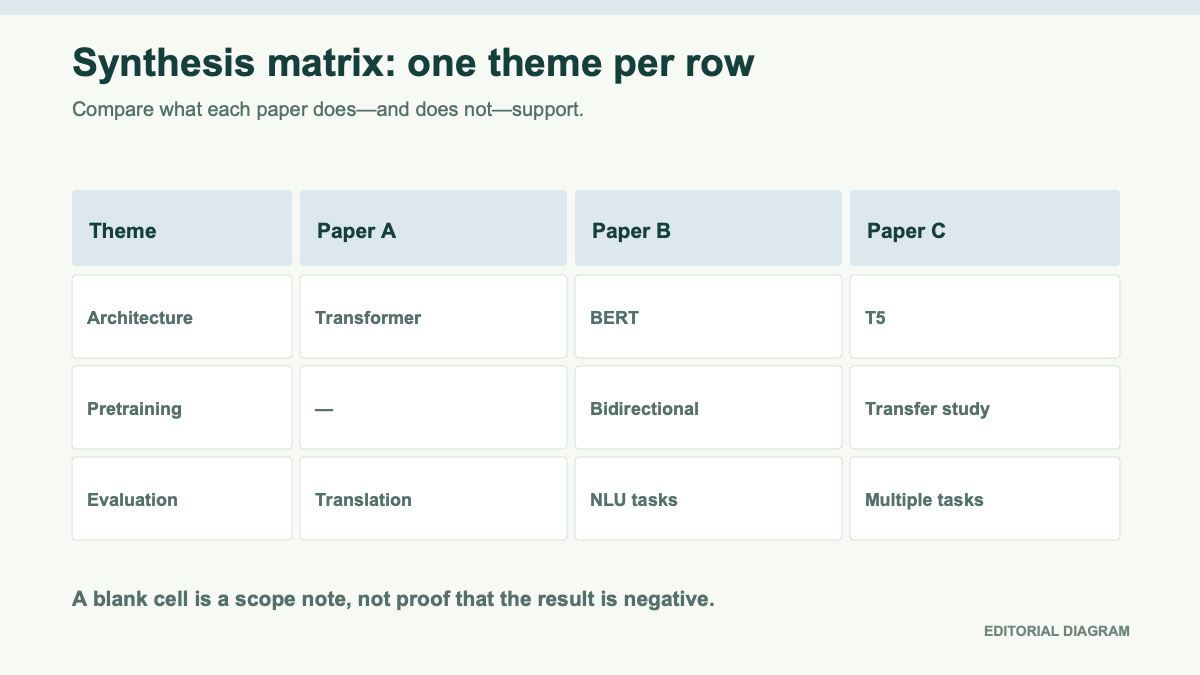
A literature matrix records each paper’s purpose, method, and findings. A synthesis matrix places themes in rows and sources in columns so you can see where evidence aligns, differs, or is absent. Blank cells are useful: they prevent an AI tool from inventing agreement.
For a source-by-source template, see the literature review matrix template.
Three checkable sources
- Vaswani et al. (2017): Transformer architecture; attention-only encoder–decoder; evaluated on machine translation.
- Devlin et al. (2018): BERT; bidirectional pretrained representations; evaluated on language understanding tasks.
- Raffel et al. (2019): T5; text-to-text framework; compared transfer-learning choices across many NLP tasks.
The example below uses claims supported by these papers’ abstracts. “Not the paper’s focus” is a scope note, not a negative finding. Inspect the full text and its version before using the matrix in academic work.
Theme × paper synthesis matrix
| Theme | Vaswani et al. (2017) | Devlin et al. (2018) | Raffel et al. (2019) |
|---|---|---|---|
| Main research focus | Attention-only Transformer architecture. | Bidirectional pretrained representations for language understanding. | Unified text-to-text transfer-learning framework. |
| Task evidence in abstract | Two machine-translation tasks; also reports parsing application. | Eleven NLP tasks, including question answering and inference. | Many understanding tasks and benchmarks including summarization, QA, classification. |
| Pretraining / transfer learning | Not the paper’s central claim. | Pretraining followed by fine-tuning is central. | Compares pretraining objectives and transfer choices. |
| Comparison caution | Translation scores are task-specific. | Understanding benchmarks differ from translation. | Results span tasks and experimental choices; avoid a cross-paper “winner.” |
Evidence locations: each cell above comes from the corresponding linked abstract. For a final review, replace “abstract” with the exact full-paper section, table, or page where you confirmed it.
Prompt for a generator
Question: How do these three papers frame Transformer-based NLP work?
Use only the three supplied papers. Make themes the rows and papers the columns.
For every factual cell, name the paper and the section/page supporting it.
If a theme is not addressed, write “not the paper’s focus”; do not infer a negative result.
Add a final row on why the studies cannot be compared with one performance number.
After the table, list every claim that still needs manual checking.
Paste excerpts or paper PDFs only when you have the right to use them and the tool fits your privacy requirements. A polished table is a draft until its cells are checked.
A defensible synthesis paragraph
These papers address different stages of Transformer-based NLP research. Vaswani et al. present an attention-only architecture with translation experiments. Devlin et al. show how bidirectional pretraining can support multiple understanding tasks. Raffel et al. examine transfer-learning design choices within a text-to-text format. The shared thread is the reuse and adaptation of Transformer ideas, but their benchmarks answer different questions; a single cross-paper performance ranking would misrepresent this evidence.
In GitMind, make branches for architecture, pretraining, task framing, and comparison limits; attach source links beside each claim. The GitMind AI tools can help organize notes, but the cited papers remain the source of evidence.
FAQ
Can AI identify a theme the papers never state?
It can propose one as your interpretation. Label it as such and show supporting passages from multiple papers before using it.
What if one cell is empty?
Leave it empty or mark it outside the paper’s scope. Do not manufacture agreement to make the table tidy.
