This literature review matrix template is ready to copy into a document or spreadsheet. A filled three-paper example shows how individual source notes become a cautious review paragraph.
Contents
Apply this in GitMind: For each paper, use GitMind File to Mind Map to sketch its question, method, findings, and limitations. Then enter only source-checked facts in the copyable matrix below. GitMind is for the visual outline; the table keeps citations and comparison details visible.
Copy the blank literature review matrix
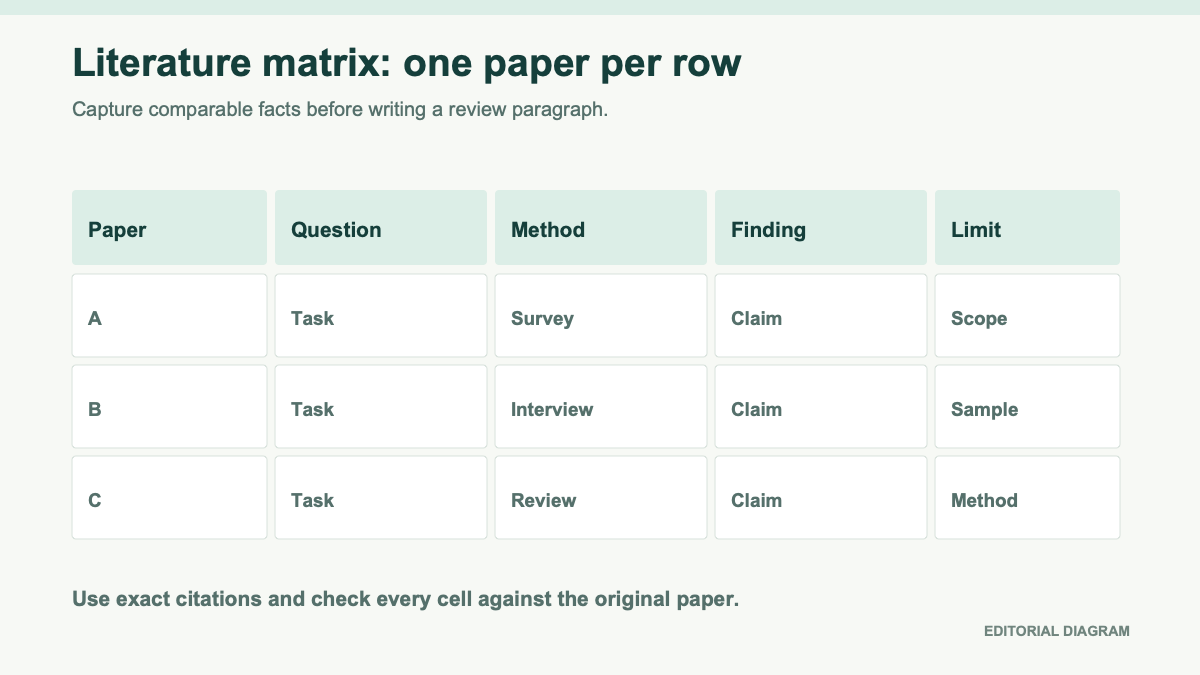
A literature review matrix keeps one paper per row. Copy the table below into a document or spreadsheet; add or remove columns to match your research question. Use “not reported” rather than guessing a missing sample or limitation.
| Source / link | Question or purpose | Method / task | Data or sample | Finding to verify | Limit / scope | How I will use it |
|---|---|---|---|---|---|---|
| [Author, year, DOI/URL] | [Exact question] | [Design, model, or approach] | [Population or dataset] | [Claim + page/section] | [Author-stated or observed boundary] | [Theme, contrast, or background] |
| [Author, year, DOI/URL] | [Exact question] | [Design, model, or approach] | [Population or dataset] | [Claim + page/section] | [Author-stated or observed boundary] | [Theme, contrast, or background] |
For a paste-ready tab-separated version:
Source / link	Purpose	Method / task	Data or sample	Finding + location	Limit / scope	Use in review
[Author, year, URL]	[Question]	[Approach]	[Dataset]	[Claim + section]	[Boundary]	[Theme]
Filled example: three open papers
The following papers share a broad transformer/NLP thread, but they ask different questions. This example records only claims visible in their abstracts; consult the full papers before quoting numbers or methods.
| Paper | Purpose / approach | Evidence location | Use in a review |
|---|---|---|---|
| Vaswani et al. (2017) | Transformer architecture; attention-only encoder–decoder; evaluated on machine translation. | Abstract | Establish architecture, task, or transfer-learning focus. |
| Devlin et al. (2018) | BERT; bidirectional pretrained representations; evaluated on language understanding tasks. | Abstract | Establish architecture, task, or transfer-learning focus. |
| Raffel et al. (2019) | T5; text-to-text framework; compared transfer-learning choices across many NLP tasks. | Abstract | Establish architecture, task, or transfer-learning focus. |
Do not insert a single “sample size” across these papers: machine-translation benchmarks and NLP tasks are not participants. If your course asks for sample size, record the relevant datasets for each paper after reading its methods section.
From rows to a literature review paragraph
Example paragraph: Vaswani et al. introduce an attention-only Transformer and evaluate it on translation tasks. Devlin et al. use Transformer-based bidirectional pretraining for language understanding, while Raffel et al. compare transfer-learning choices in a text-to-text framework. Together, these works illustrate a movement from architecture design toward reusable pretraining and task framing; they do not, by themselves, establish which approach is best for every NLP task. Cite the individual papers for each factual clause and verify the relevant sections before submission.
A source matrix stores details paper by paper. When you need a theme-by-paper comparison, use the companion synthesis matrix example. In GitMind, put the review question at the center and branch by themes; attach verified rows as notes rather than treating the map as a citation manager.
Check each row before writing
- Open the original paper; record its stable URL, DOI, or repository page.
- Separate the authors’ claim from your own interpretation.
- Note the precise section or page for a claim you expect to cite.
- Do not infer limitations merely because an abstract omits a topic.
- Write comparison sentences only after at least two rows contain evidence on the same theme.
The arXiv repository provides the three open paper pages linked above. Repository access does not replace checking the version and publication details required by your citation style.
FAQ
Is this a downloadable file?
The blank table and tab-separated line above are directly copyable. No separate download is required.
How is a literature matrix different from an annotated bibliography?
The matrix puts comparable fields side by side, which makes cross-paper patterns easier to find.
