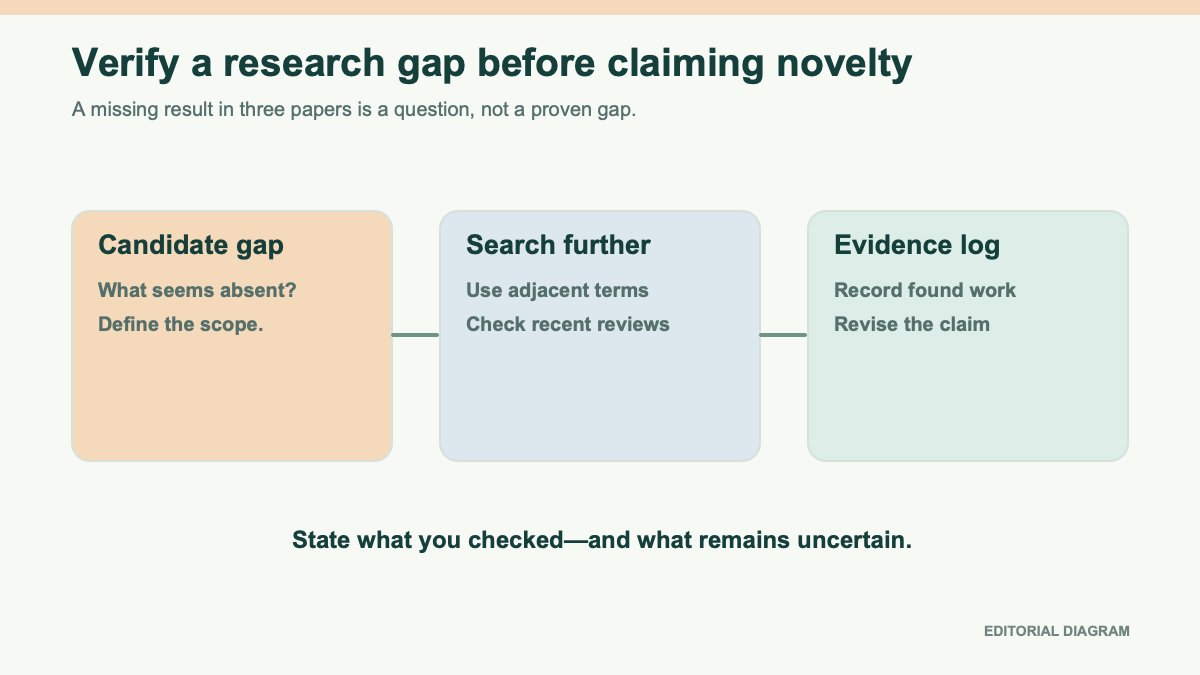
Answer first: Research gap finder AI can help you spot candidate gaps, but it cannot prove a gap exists by itself. Treat its output as a hypothesis: check recent papers, review articles, methods, populations, and contradictory findings before building a proposal around it.
research gap finder AI is worth targeting because the searcher usually has a real task in front of them, not a vague curiosity. The next step is to define the source material, choose the output you need, and leave time for human review.

Contents
What research gap finder AI means and when to use it
A research gap is a meaningful missing piece in existing knowledge. It may involve an understudied population, method limitation, conflicting results, outdated evidence, missing context, or a practical problem that current research has not addressed well.
Students and researchers want a topic gap, thesis angle, or proposal idea. The risk is accepting a gap that is only new to the tool, not new to the field.
This keyword is attractive because it combines academic anxiety with AI discovery tools. It can rank with a careful article that explains types of gaps, verification, and ethical use instead of promising instant thesis topics.
Quick decision table
Start here if you are deciding whether this workflow is the right fit. The table keeps the first decision practical: who should use it, what it helps with, and where it can go wrong.
| User or scenario | How to use it well |
|---|---|
| Graduate students | Use it to brainstorm proposal angles after reading recent review papers. |
| Undergraduate researchers | Use it to narrow a broad topic into a feasible class project. |
| Research teams | Use it to generate discussion prompts, then validate with database searches. |
| Content strategists in research-heavy fields | Use it to spot unanswered audience questions, while separating market gaps from academic gaps. |
| Fit | Judgment |
|---|---|
| Best for | Early brainstorming, proposal framing, literature review planning, and topic narrowing. |
| Not best for | Proving novelty, replacing database searches, or making unsupported academic claims. |
How to choose the right tool or template
Do not choose only by the first result or the nicest interface. The safer approach is to match the tool to your source material, output format, review needs, and privacy rules.
| Selection factor | What to check |
|---|---|
| Source freshness | Does the tool consider recent papers and not only old summaries? |
| Evidence trail | Can it show why a gap may exist and which papers support that claim? |
| Gap type | Does it distinguish population, method, theory, data, context, and application gaps? |
| Search breadth | Can you compare results across databases, citation maps, and review papers? |
| Feasibility | Can the gap become a research question you can actually study? |

Cost and total price considerations
Many AI tools advertise a free starting point, but the real total cost is usually a mix of plan limits, file size, exports, review time, and team approval. Pricing changes often, so confirm current plan details on the official page before buying.
| Cost item | How to judge the total cost |
|---|---|
| Free plan | Good for brainstorming gap categories and search terms. |
| Paid plan | Consider if you need citation maps, full-paper analysis, saved projects, or team collaboration. |
| Hidden cost | Database access, source screening, and advisor review can matter more than the AI fee. |
| Total cost to budget for | Tool fee plus paper access, search time, research design review, and possibly ethics approval preparation. |
A practical research gap finder AI workflow
The order matters. If you generate before defining the task, the output may look polished while still missing the real goal. Use this workflow as a checklist.
- Start with one focused topic, not a whole discipline.
- Collect recent review articles and highly cited papers.
- Ask the AI tool for candidate gaps by type: population, method, setting, theory, or conflicting findings.
- Use GitMind to map evidence for and against each candidate gap.
- Search recent papers manually to see whether the gap has already been addressed.
- Turn the strongest gap into a research question with scope, method, and data needs.

Where GitMind fits naturally
GitMind is useful when the generated output needs structure. For this topic, the most helpful role is not replacing the specialized tool. It is organizing source material before generation and organizing weak points, themes, or tasks afterward.
For long documents, start with GitMind article summarizer, GitMind AI tools. A mind map makes it easier to see what belongs in the prompt, what should be excluded, and what needs human verification. After the AI tool creates a draft, put the reviewed items back into GitMind as branches for study, research, teaching, or project follow-up.

Limits, risks, and checks before you rely on the output
AI can compress tedious work, but it can also hide errors behind clean formatting. Before you share, submit, grade, or make decisions from the result, run these checks.
| Risk | What to do before using the output |
|---|---|
| False novelty | A tool may call something a gap because it did not retrieve the newest or most relevant papers. |
| Too broad | A gap like more research is needed is not useful. Define who, where, method, outcome, or context. |
| Unsupported claims | Every gap statement should be backed by sources, ideally recent reviews or a clear pattern across studies. |
| Feasibility | A real gap may still be impossible for your budget, timeline, data access, or ethics approval. |
For broader context and tool examples, see AnswerThis Research Gap Finder, Litmaps guide to finding research gaps. Treat those pages as references for product capabilities, then adapt the workflow to your own classroom, research project, document, or team process.
FAQ
Can AI prove that my research gap is original?
No. AI can suggest possible gaps, but originality needs database searches, recent reviews, and advisor or peer review.
What are common types of research gaps?
Common types include population gaps, method gaps, theory gaps, evidence conflicts, contextual gaps, practical application gaps, and outdated evidence.
How do I turn a gap into a research question?
Define the population, setting, variable or phenomenon, method, and outcome. A good gap becomes specific enough to study.
What sources should I check after AI suggests a gap?
Check recent review articles, highly cited papers, citation maps, and database searches in your field.
Can a gap be too small?
Yes. A small gap may not justify a full thesis unless it affects theory, practice, policy, or a clearly defined population.
How does GitMind help with research gaps?
GitMind helps map candidate gaps, supporting papers, contradictory evidence, and feasibility notes so you can compare ideas before committing.
Next step
Pick one source file or one narrow task and run a small test before changing your whole workflow. If the output is accurate, editable, and easy to review, expand from there. If it creates more checking work than it saves, simplify the prompt or use GitMind first to clarify the structure.